Undergrad team launches tash, an investment platform for trading cards

Haas News
The Haas AI Living Labs initiative integrates human-centered AI into teaching, research, operations, and industry partnerships.

In Brief
Park Sinchaisri doesn’t just teach operations management—he builds games for it using agentic AI. In one, students learn supply chain coordination through managing a Boba Empire. His newest game puts teams in charge of a sneaker factory, where the real test isn’t whether students can plan but whether they notice when a plan stops working as conditions change.

“Teams that keep reading their own operating data catch it,” says Sinchaisri, an assistant professor whose research examines human-AI interaction at work and how AI can improve human decision-making. “Teams that built a plan and stopped watching don’t. Performance is measured well after they’ve lost the ability to intervene, so what they leave behind matters as much as what they do in the moment.”
Agentic AI makes the games easier than ever to not only design and build, but to test their effectiveness before introducing them into the classroom. “I could design a game before, but what I couldn’t do was prove it taught what I thought it taught,” he says. Now, he runs the simulation thousands of times against automated opponents before assigning it in class. Several intended lessons that didn’t survive scrutiny were cut.
Across Haas, roughly 40 classes like Sinchaisri’s have been revamped or newly created to reflect AI’s profound impact on teaching and learning. Faculty are breaking new ground not only in how they use AI tools in the classroom, but how they use it to improve and expand their own research. At the same time, faculty researchers are examining how AI is changing markets, organizations, and workers, and bringing those insights into the classroom.
This fall, AI was named among Dean Jenny Chatman’s four schoolwide strategic initiatives, which also include Entrepreneurship, Healthcare, and Sustainability & Social Impact—interdisciplinary areas where the school has deep strengths and expertise and where the challenges and opportunities for business and society are most urgent. The AI initiative, known as the Haas AI Living Labs, is led by Associate Professor Mathijs De Vaan.
Humans can develop trust and relationships, be held accountable, navigate organizational politics, and contextualize key strategic decisions. That’s hard for a machine to replicate, which I think positions our MBA graduates well in an AI-driven labor market.”
—Associate Professor Mathijs De Vaan, Faculty Director, Haas AI Living Labs
De Vaan, a sociologist who teaches leadership, says the faculty is focused on three critical areas: using AI tools responsibly for things like prompting, setting up agents, and verifying outputs; integrating AI to enhance the learning experience with simulations, chatbots, and tools that simplify dense material; and for teaching how AI will reshape the future of work—from job design to how colleagues collaborate.
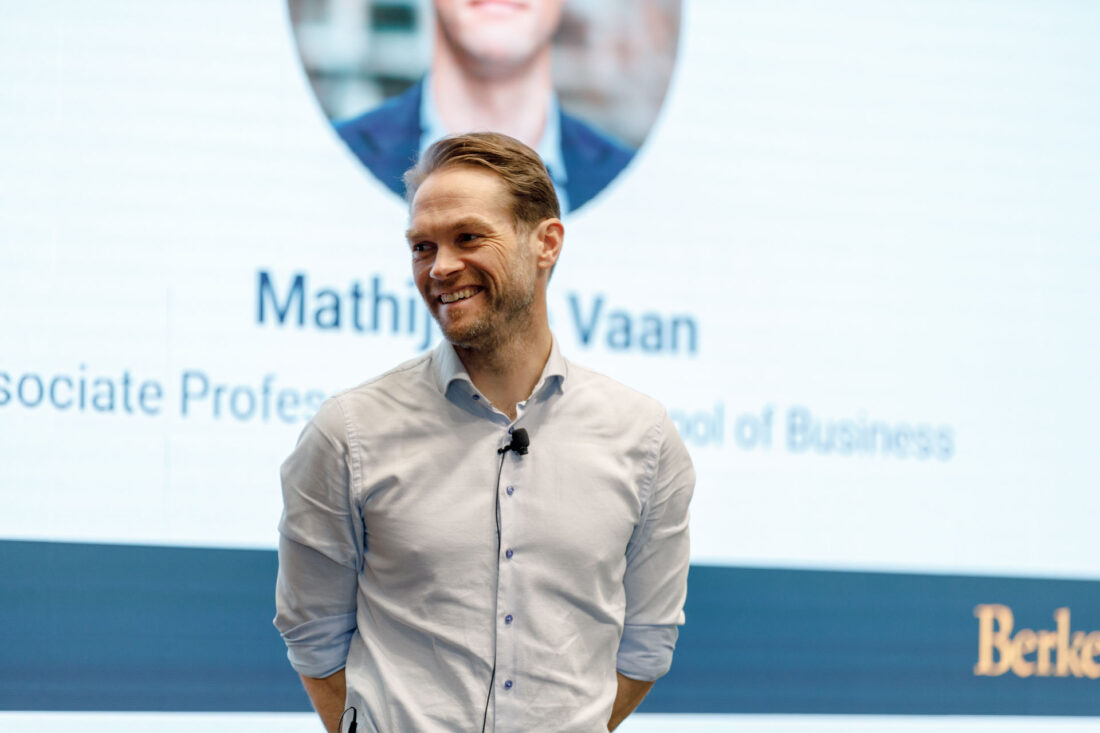
“Haas students are at the center of one of the most consequential technological shifts in history, and our role is to prepare them to use AI within organizations while doubling down on distinctly human capabilities,” De Vaan says. “Humans can develop trust and relationships, be held accountable, navigate organizational politics, and contextualize key strategic decisions. That’s hard for a machine to replicate, which I think positions our MBA graduates well in an AI-driven labor market.”

De Vaan has led significant progress for the Haas AI Living Labs already, including:

In many ways, Haas has been preparing for years for how AI would create a generational shift. In 2018, four years before OpenAI introduced its first version of ChatGPT, professors Jon Kolstad and Paul Gertler were teaching Big Data and Better Decisions, which trained MBA students to second-guess AI as leaders trained to understand data analytics.
By 2025, the MBA program had expanded to offer nearly 30 courses related to AI in areas ranging from responsible use to using AI tools for business success. Haas then rolled up its offerings in a new AI certificate for MBA students. The certificate, which an estimated half of the Class of 2027 will earn, is designed to let students build AI capabilities, whether that’s leading a team, founding a company, or transforming an industry, says Erika Walker, senior vice dean of instruction.
Last year, Chatman asked a group of faculty that included professors Zsolt Katona, Sameer Srivastava, Martin Beraja, and De Vaan to develop a proposal to accelerate how Haas is using and teaching AI—resulting in the strategic initiative. Then, over the summer, Chatman asked faculty and staff last spring to think deeply about how they were using AI, calling for a “summer of AI integration.”
Professional faculty members Joe Wadcan, MBA 12, and Vince Law, a “double Bear” with two engineering degrees from UC Berkeley, took Chatman up on the plan. Wadcan and Law, both early adopters of AI in the classroom, met with nearly 50 faculty members teaching MBA core classes to talk through ways to optimize the use of AI in their teaching.
“A lot of faculty are keen on making sure that the AI experience doesn’t feel sloppy, which is so easy with AI,” Law says. “At the end of the day, the student experience is the common denominator, and the fact that many faculty members have expressed this has been great.”
Professor Alex Mas, co-associate dean for Academic Affairs, says AI has opened up possibilities that make teaching more exciting than it’s been in years. “You have to meet the moment,” says Mas. “Before you had data engineers, data scientists, analysts, and product managers, and each took input from the other. Now, with AI, one person can build something in three hours that would have taken six months.”

Over the summer, Mas and Pepe Alonso, MBA 27, an AI intern at Google, created the Fundamentals of Agentic AI class, which takes students through the basics of software and machine learning to tools and multiagent systems before tasking students with building agents themselves. Alonso says he wants students to go beyond the superficial to prepare them for a changing job market. “That means that you actually understand what is going on under the hood because companies want someone to take ownership and responsibility,” he says.
AI is surely demanding a new level of understanding and new skills, and the workplace shift will require students to cultivate psychological and professional agility. Workers will need “the ability to abandon a plan despite having invested in it, to reskill often, to refocus on opportunities as they arise, and to let go of our professional identities so we can adapt them as circumstances evolve,” Professor Toby Stuart wrote in a recent Harvard Business Review article.
MBA students and graduates also need to trust their instincts. “I need people to go out there and recognize fake statistics, bad handling of data, or bad sampling,” says economics Professor Francesco Trebbi, who teaches Data and Decisions. During a fall full-time MBA orientation session, Trebbi emphasized “vigilant human supervision” in finance.

For Wadcan, who teaches Intro to Coding for MBAs, creating a level of agility is top of mind. Previously, his students built one app over 10 weeks. Now, they build 10 apps in 10 weeks. “Students have the ability to do so much more,” he says. “AI is helping them get to the levels that they need to be at a time when they need to learn it. I think it’s really profound, especially in programming and coding.” Wadcan also teaches Sales for Startups, using a choose-your-own-adventure simulation he built that lets students run a sales organization from the founding stage onward, selecting their own topics and level of challenge.
AI is also deepening student engagement, and some professors are encouraging students to use voice-to-voice chatbots to discuss assignments before class. In De Vaan’s Leading People course last fall, Akshita Dutta, EWMBA 29, used chatbot conversations that prompted her to go deeper on how she sees herself as a leader and to discuss ideas beyond the assigned case. That work challenged her thinking in ways a written assignment wouldn’t have, she says.

Dutta also took quizzes De Vaan built with Gemini and listened to his AI-generated podcast to refresh her memory on a case she had read earlier in the week. “I was hoping that we would have something like this when I came to Haas, so it was great that he was so up-to-date with how he wanted to deliver his material,” she says.
On the back end, De Vaan reads transcripts from students’ chatbot conversations to inform his class case discussions. So does Law, who 30 minutes before class, runs a query to see where people are getting hung up in the pre-work and adjusts his teaching that day based on the information he collects.
This fall, Law is running a pilot, offering students who opt in feedback on how they’re using Claude to do their homework—and giving advice on how they can improve. “The entire education paradigm we’ve lived through focuses on evaluating the outputs and assignment, but that’s practically dead when the outputs are being generated by AI,” he says. “Now the question becomes: ‘How do we actually start to understand the inputs to AI that students are using to get the results that they’re getting?’ I think that’s a big leap, very experimental.”
For many students, agentic AI has become a thought partner that they use to fail quickly and try again, another way to develop workplace resilience. Jim Hornthal, a professional faculty member who teaches the Lean LaunchPad startup course, says his students, by the first day of class, should understand the value of working with AI “co-founders” who collaborate with them to build robust initial business models. These models include financial dashboards that will help them identify their riskiest ideas. Then they get out of the building to curate the problem, he says. “Actual interviews are needed to validate or invalidate these key hypotheses,” he says.
While AI might be a helpful online assistant, real-world thought partners can also be found campuswide. On any given day, execs from companies OpenAI, Anthropic, Perplexity, Google, Meta, Apple, Nvidia, and AMD speak in classes, attend hackathons, and volunteer as mentors. These execs, who work in the center of the AI boom in nearby San Francisco and Silicon Valley, contribute in many ways—from providing industry insights to giving quick feedback on a startup idea to providing practical tips for landing a job in a particular AI role.

As co-president of the AI Club at Haas, Devansh Shah, MBA 27, hosted a dinner series with local AI leaders to provide access beyond larger speaker events. “We’ll pick a restaurant and have maybe 10 to 15 students in a small, intimate setting and just have a more unfettered conversation about what’s really happening in their worlds and how they should think about their careers,” he says. “It’s been a pretty big unlock.”
Ayushman Dey, MBA 26, who is on the AI & Agents team developing AI search and retrieval features at Snowflake, credits his career momentum to the access to AI leaders and opportunities at Haas. Aside from landing his MBA internship at Snowflake through the Haas Career Management Group, Dey also started working with a deep-tech spinout from Lawrence Berkeley National Lab while at Haas, advising the scientist-founder on product and commercialization.
In entrepreneurship classes and programs, including the UC LAUNCH accelerator, the Student Entrepreneurship Program (StEP), and the NSF I-Corps program, which advances science by funding research proposals, AI is turbocharging startup development. “The hard part isn’t building anymore—it’s knowing you’re solving a real problem that people actually want solved,” says Kelly Ochoa, director of the 10-week StEP incubator, who adds that she’s adjusted the program’s pacing to match.

Andrew Madigan and Justin Keller, both MBA 27, used AI simulations to build startup Populous within a semester in the spring 2026 AI Entrepreneurship course, taught by entrepreneur Alex Zekoff, MBA 17, with Associate Professor Omri Even-Tov. Keller, who worked in consulting before coming to Haas, says he and Madigan bonded during their first semester over the need to replace expert interviews with customers, which are time-consuming and can cost up to $1,000 an hour, with something better, using AI.
The pair worked with mentor Aayush Agarwal, MBA 25, a senior product manager at Uber, on startup Populous, which uses LLMs to replace customer discovery with simulated populations businesses can use to test products quickly. The startup recently raised $100,000 in a pre-seed round from early investors.
“What is unique about Berkeley is the entrepreneurial spirit. I got into it just because so many of my peers were doing it, and it became so attainable,” Keller says. “And having traveled a bit, being in the Bay Area, you’re at least a year in the future.”

In addition to developing entrepreneurial skills, Haas is training students to understand how and when to use AI across different workplace scenarios—from creating new efficiencies to strategy to decision-making.

Over the summer, Associate Professor Aruna Ranganathan challenged students in her Managing People in the Global Context class to complete four missions, each pairing an AI tool with a human encounter. The first team to collect all the required proof and reach the finish line won.
Each stop included an AI side task such as using an app or service to do something a human traditionally would, paired with a “human” side task like tracking down a real person who was doing that same job and asking them how they felt about it. After each stop, students had to submit a photo or video and a voice memo as proof before getting the next clue.
“At every stage, students also had to write about the experience—weighing AI versus human trade-offs and thinking about the future of work,” Ranganathan says.
As an evening & weekend MBA student, Dutta says she’s balancing her use of AI with human judgment every day at work in product management at Altos Labs, a Redwood City, California-based biotech startup. While AI workflows in scientific research are increasing efficiency, they still require significant human oversight because biological problems don’t map cleanly onto typical LLM question-answering, she says.
“Soft skills are going to matter a lot more than your technical and hard skills, that’s a given,” she says. “I think you need to be able to work well with people rather than just working in silos.”
“Soft skills are going to matter a lot more than your technical and hard skills, that’s a given. I think you need to be able to work well with people rather than just working in silos.”
—Akshita Dutta, EWMBA 29
To stay connected to what the MBA students are experiencing in the classroom and at work or in their internships, student AI fellows (Shah and Camila Scotti Pinto, MBA 27, are current fellows) will liaise with the dean’s office and the faculty.
De Vaan, who meets regularly with these students, says it’s part of the holistic approach Haas is taking to AI. “Specific jobs are going to change, the design of organizations is going to change, the way that we informally interact with colleagues will change, and how we manage groups of people is going to change,” De Vaan says “What this will look like exactly is an open question. We don’t have answers yet about what the future will look like. But we think it’s really important for all of us to be thinking together about this.”
Amy Marcott and Laura Counts contributed reporting for this story.
Posted in:
Topics:

Professor Lee Fleming receives 2026 best paper prize in strategy
The Strategic Management Society recognized Fleming's influential research showing how scientific knowledge can guide inventors through complex technological problems.

